← Back to home

Updates

Research highlights

July 2026 Preprint

Thermal avalanches in a quasiperiodic XXZ model

P. Molignini and A. Štrkalj, arXiv:2607.21708 (2026)
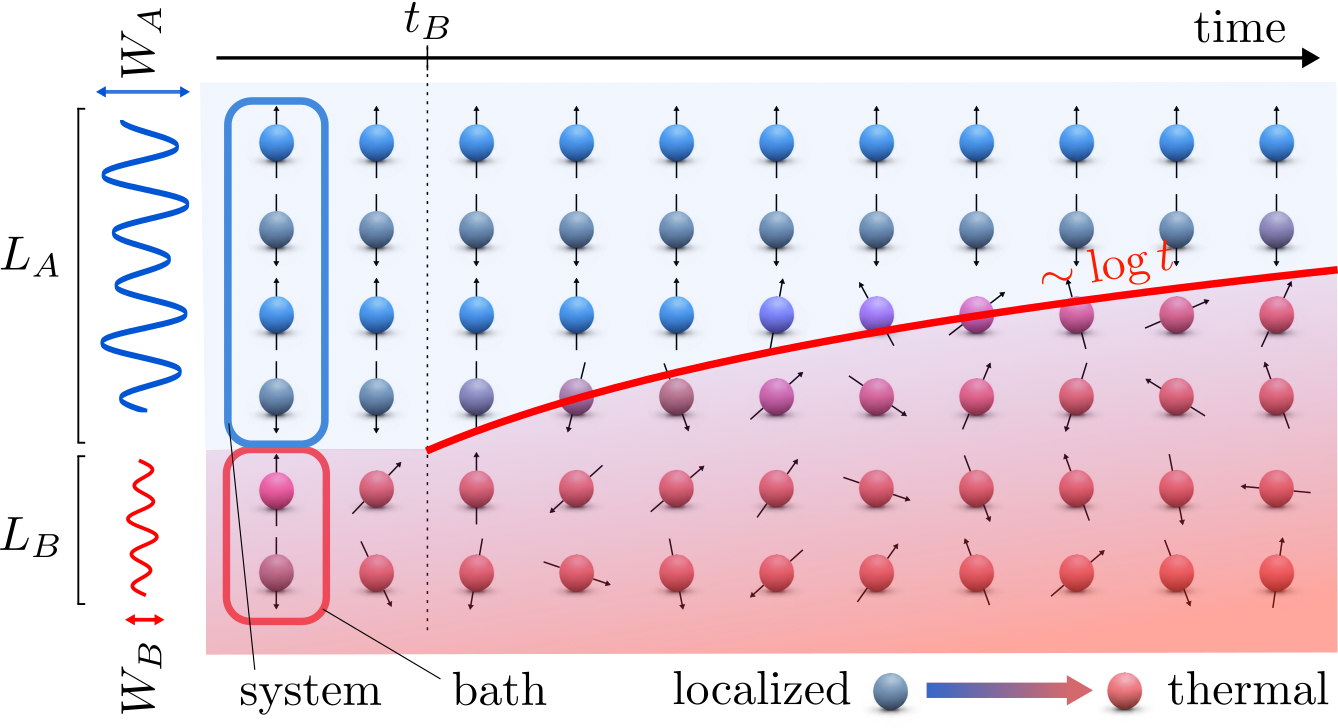
Thermal avalanche spreading from a bath into a localised quasiperiodic spin chain

Many-body localisation (MBL) allows interacting quantum systems to avoid thermalisation - preserving memory of their initial state indefinitely. Its stability, however, is threatened by "quantum avalanches": a small thermal region can absorb its localised neighbours one by one, growing until the whole system thermalises. In randomly disordered systems, such regions arise naturally as rare patches of weak disorder are guaranteed to occur. Quasiperiodic systems, which are deterministic, have no such rare regions, so it is unclear whether and how avalanches unfold in them.

We numerically study this question in an XXZ spin chain in a quasiperiodic magnetic field, with an implanted thermal region acting as a small bath. We track the dynamics with two experimentally accessible observables and find that they tell strikingly different stories. Two-point correlations show no sign of an avalanche and suggest that the localisation lengths remain below the avalanche threshold. The particle-number entropy, by contrast, reveals a thermal front propagating steadily into the localised region once the bath is large enough. Two-point correlations are therefore unreliable avalanche diagnostics in quasiperiodic systems, unlike in random ones. The results agree qualitatively with standard avalanche theory but deviate from it quantitatively, which we attribute to short-range resonances generated by the quasiperiodic potential. This suggests that the theory needs revising for quasiperiodic systems.
June 2026 Article

Localization and topological signatures under periodic twisting

J. Walkling, A. Štrkalj and F. N. Ünal, Phys. Rev. Research 8, 023356 (2026)

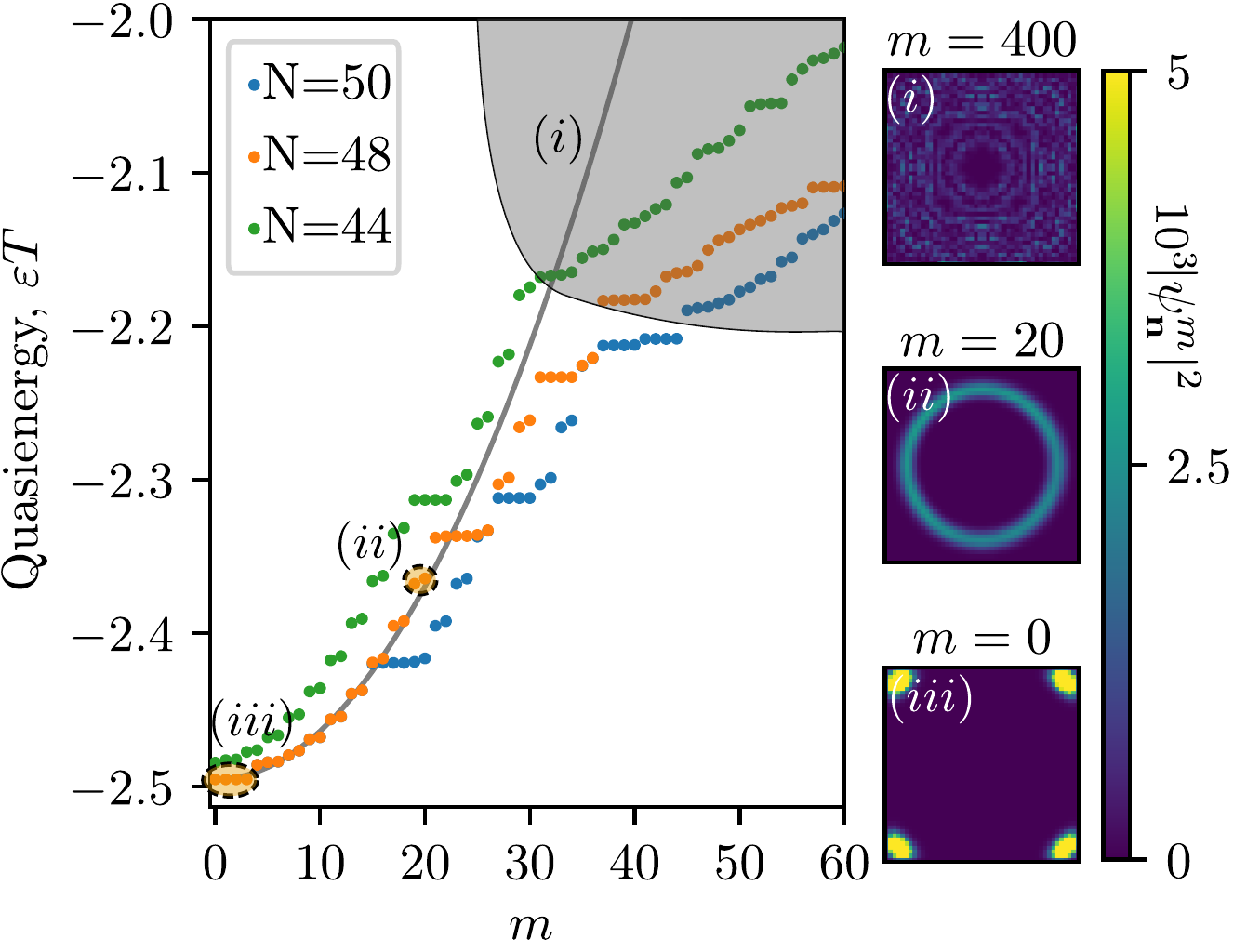
Quasienergy spectra showing ring and pocket states under periodic twisting

Overlaying two square lattices at a relative angle produces a quasiperiodic pattern, a two-dimensional version of the Aubry–André model, in which particles can become localised even without any disorder. Static twist angles already produce rich physics. We ask what happens when the twist itself becomes dynamical, with one lattice rotating continuously relative to the other.

We find that periodic twisting acts as an unusual drive: a particle experiences a multi-frequency modulation whose character depends on its distance from the rotation axis. As a result, the quasiperiodicity that governs the static problem no longer plays the central role. Instead, the particle's motion is controlled by a local, spatially varying form of dynamical localisation, which gives rise to ring-shaped states confined within the bulk, with distinctive transport signatures. Using the Bott index and the local Chern marker, we also uncover a rich variety of states with non-trivial topological signatures. The most common appear as fairly uniform rings of Chern marker, and they arise from hybridisation between delocalised ring states. We discuss how these effects could be realised in quantum simulators, such as ultracold atoms in optical lattices. Our work opens a new direction for driven systems, in which rotation generates spatially structured Floquet driving.

March 2026 Preprint

Quantum Beats in Many-Body Localized Systems

B. Faulend, H. Buljan and A. Štrkalj, arXiv:2603.28721 (2026)

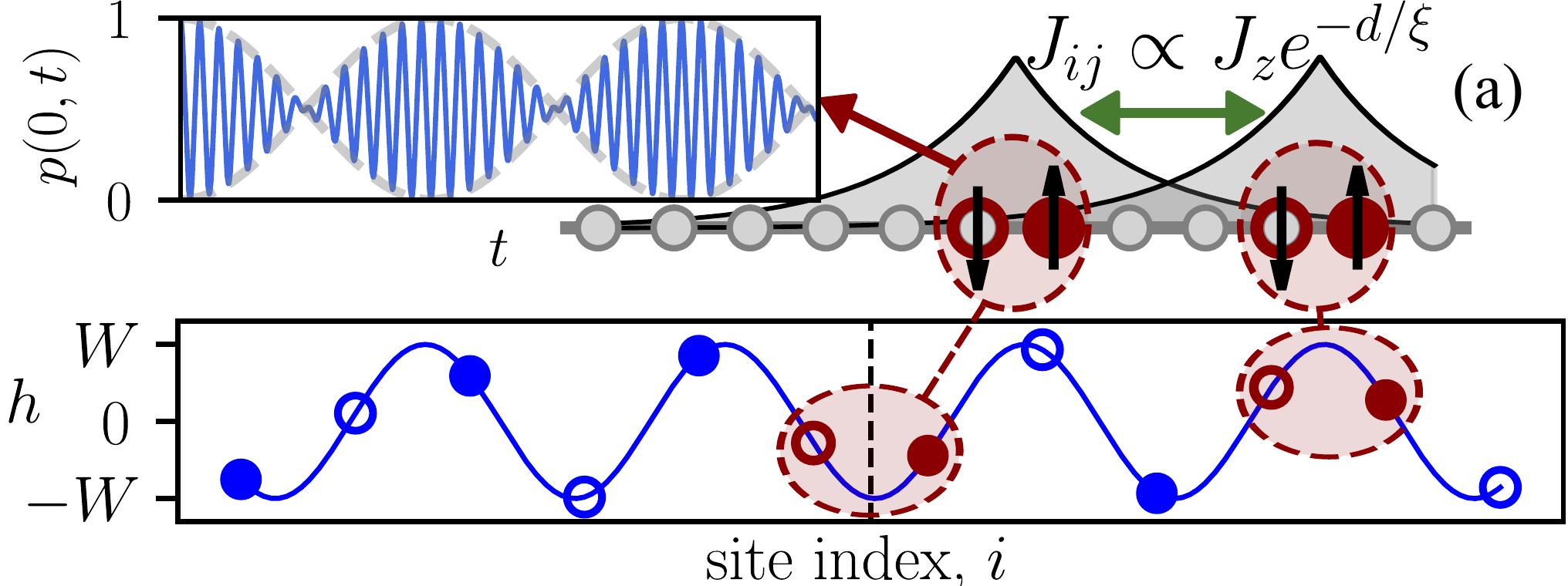
Many-body quantum beats between two resonant pairs in a quasiperiodic chain

Many-body localised (MBL) systems are expected to freeze: interactions and a strong random or quasiperiodic potential together prevent particles from moving and the system from thermalising. Yet numerical simulations have repeatedly shown slow particle dynamics even deep in the localised regime, which has raised doubts about whether MBL survives in large systems. The microscopic origin of this slow dynamics has remained unknown.

We show that it comes from many-body quantum beats. A particle hopping back and forth between two nearly resonant sites oscillates like a two-level system, and weak interactions with a second such hopping process elsewhere in the chain slowly modulate the amplitude of that oscillation. This modulation lets particles spend more time delocalised between neighbouring sites, producing the slow growth of particle fluctuations seen in simulations, without any long-range transport. The effect survives at arbitrarily large distances, is consistent with a stable MBL phase, and is generic to many-body systems.

Using quasiperiodic potentials, where the positions of resonances can be controlled, we build an analytical model that reproduces the exact numerics at all accessible timescales and explains the different behaviour seen in quasiperiodic and random systems. We also propose how to observe quantum beats directly with ultracold atoms, where measuring the beat timescale would give a direct probe of interactions between the local integrals of motion that underpin MBL.

May 2025 Article

A resonant valence bond spin liquid in the dilute limit of doped frustrated Mott insulators

C. Glittum, A. Štrkalj, D. Prabhakaran, P. A. Goddard, C. D. Batista and C. Castelnovo, Nature Physics 21, 1211 (2025)

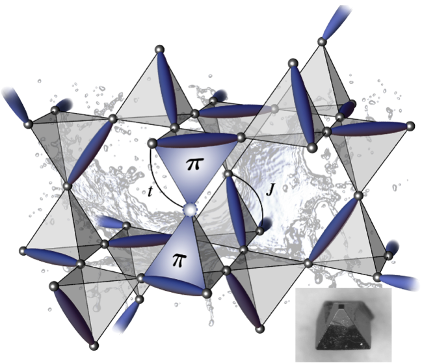
Resonating valence bond state on a kinetically frustrated pyrochlore lattice

In the early 1970s, Anderson and Fazekas proposed that the spins in some magnets never settle into an ordered pattern. Instead, neighbouring spins pair up into quantum singlets, and these pairs constantly resonate between different arrangements. This "resonant valence bond" (RVB) state later became a candidate for explaining high-temperature superconductivity. It also gave rise to some of the central ideas of modern condensed matter physics: quantum spin liquids, emergent gauge fields, topological order and fractionalisation. Yet despite five decades of effort, a clean realisation of their original idea in a realistic electronic model had remained elusive.

We show that such a state appears naturally when a strongly correlated Mott insulator on a lattice of corner-sharing tetrahedra, such as the three-dimensional pyrochlore or the planar chequerboard lattice, is doped with a small number of holes. The key ingredient is not frustrated magnetic interactions, the usual suspect, but frustrated motion. This turns a classic puzzle on its head: in Nagaoka's famous result, a single hole makes the spins align ferromagnetically, but on these lattices the hole's frustrated motion instead drives the spins into a quantum liquid of singlets. In a ferromagnetic background, the different paths a hole can take around each triangle cancel each other out, so the hole cannot lower its energy by moving. The spins lift this cancellation by pairing up into a resonating superposition of singlets, which lets the hole move and lowers the total energy. We prove this analytically for a single hole and confirm it numerically with exact diagonalisation and DMRG, finding an exact wavefunction for one and two holes at any system size. The resulting state shows spin–charge separation: the electron's spin and charge move independently.

Our work points to kinetic frustration in doped Mott insulators as a new route to realising quantum spin liquids. We also identify pyrochlore iridates and copper-based compounds as candidate materials for testing this experimentally.

See also News & Views: "A model spin liquid" (D. Poilblanc) and JCCM commentary: "Nagaoka problem and RVB: an unexpected connection" (F. Mila).

February 2024 Article

Tomasch oscillations as above-gap signature of topological superconductivity

A. Štrkalj, X.-R. Chen, W. Chen, D. Y. Xing and O. Zilberberg, Phys. Rev. Lett. 132, 066301 (2024)

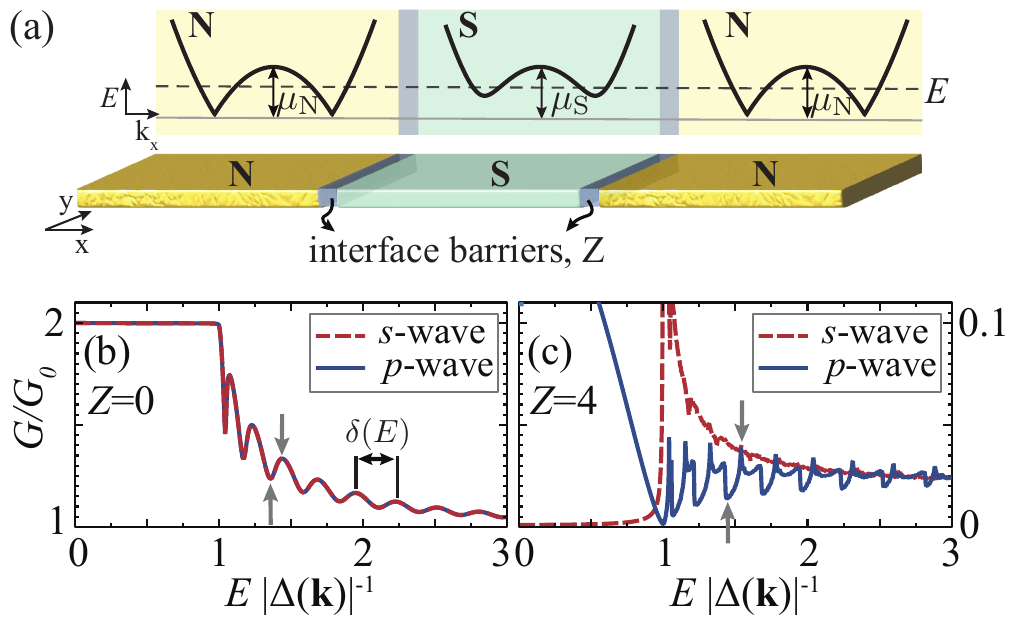
Normal-metal/superconductor/normal-metal junction and conductance showing Tomasch oscillations for s-wave and p-wave pairing

Topological superconductors are usually identified by searching for topologically protected states inside the superconducting gap, such as Majorana modes. In current experiments, however, clear-cut evidence for these in-gap states is still lacking, and similar signals can arise from trivial effects induced by disorder.

We propose a complementary probe based on transport at energies above the gap. In a two-dimensional normal-metal/superconductor/normal-metal junction, quasiparticles above the gap are scattered back and forth inside the superconducting region, which acts as a cavity. Their interference produces Tomasch oscillations in the conductance, a geometric resonance first seen in lead and indium films some sixty years ago, with maxima set by the difference between electron- and hole-like wavevectors and the length of the superconductor.

Comparing a conventional s-wave superconductor with a topological chiral p-wave one, we find that both show the same oscillations when the interfaces are transparent, but they respond oppositely to interface barriers: the oscillations fade for s-wave pairing and become more pronounced for p-wave pairing. The reason is the momentum dependence of the p-wave pairing, which couples different standing modes of the cavity and opens secondary gaps above the main gap that survive even in the tunnelling limit. Since these coherent oscillations are suppressed by disorder, our proposed mechanism is robust against a common false positive indentification of the non-trivial topology. We discuss candidate materials such as Sr₂RuO₄ and UTe₂, where the barrier strength can be tuned in junction experiments.

November 2022 Article

Coexistence of localization and transport in many-body two-dimensional Aubry-André models

A. Štrkalj, E. V. H. Doggen and C. Castelnovo, Phys. Rev. B 106, 184209 (2022)

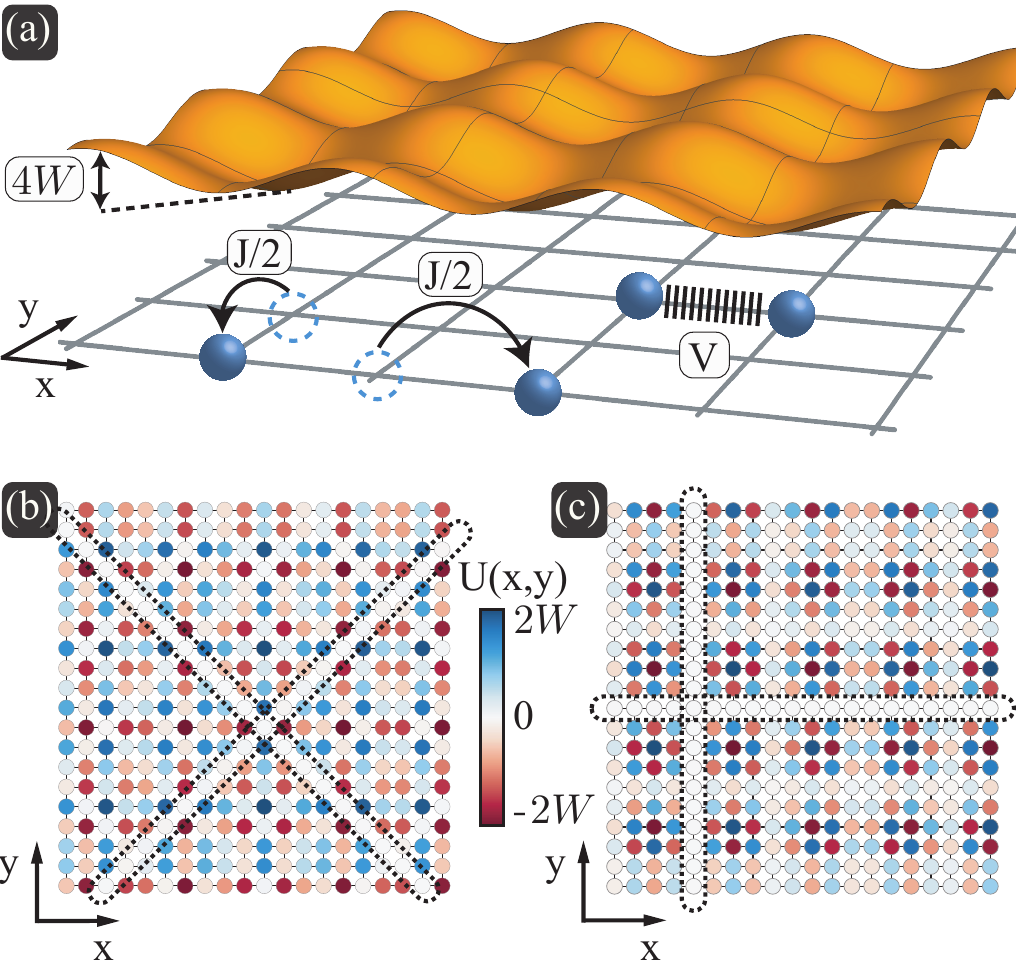
Interacting particles in a two-dimensional Aubry-André potential with lines of weak potential

Many-body localisation (MBL) allows interacting quantum systems to avoid thermalisation, but whether it survives in the thermodynamic limit, and in particular in two dimensions, is the subject of intense debate. In random systems, rare regions of weak disorder can seed thermal avalanches that destabilise the localised phase. Quasiperiodic potentials are deterministic and have no such rare regions, which makes them a promising setting for MBL in higher dimensions.

We study interacting hard-core bosons on a square lattice with two-dimensional Aubry–André potentials, built from two incommensurate cosine modulations either aligned with the lattice axes or rotated by 45°. Using the time-dependent variational principle with matrix product states, we follow the dynamics for about a hundred hopping times on lattices of up to 8×8 and 16×5 sites, and track the memory of an initial density pattern through the particle imbalance. We find a many-body localised phase at strong potential whose critical strength, unlike in random two-dimensional systems, does not drift with system size, indicating that MBL is more stable in quasiperiodic systems.

The aforementioned realisations of the 2D Aubry–André models contain deterministic lines of arbitrarily weak potential. Particles can move along these lines even deep in the localised phase, without thermalising the surrounding bulk. Localisation and transport therefore coexist, in a way reminiscent of supersolids, which combine crystalline order with frictionless flow. The effects can be tested with ultracold atoms, by superimposing a deep and a shallow square optical lattice at a relative angle of 0° or 45°.

July 2020 Article

Electron-hole interference in an inverted-band semiconductor bilayer

M. Karalic, A. Štrkalj, M. Masseroni, W. Chen, C. Mittag, T. Tschirky, W. Wegscheider, T. Ihn, K. Ensslin and O. Zilberberg, Phys. Rev. X 10, 031007 (2020)

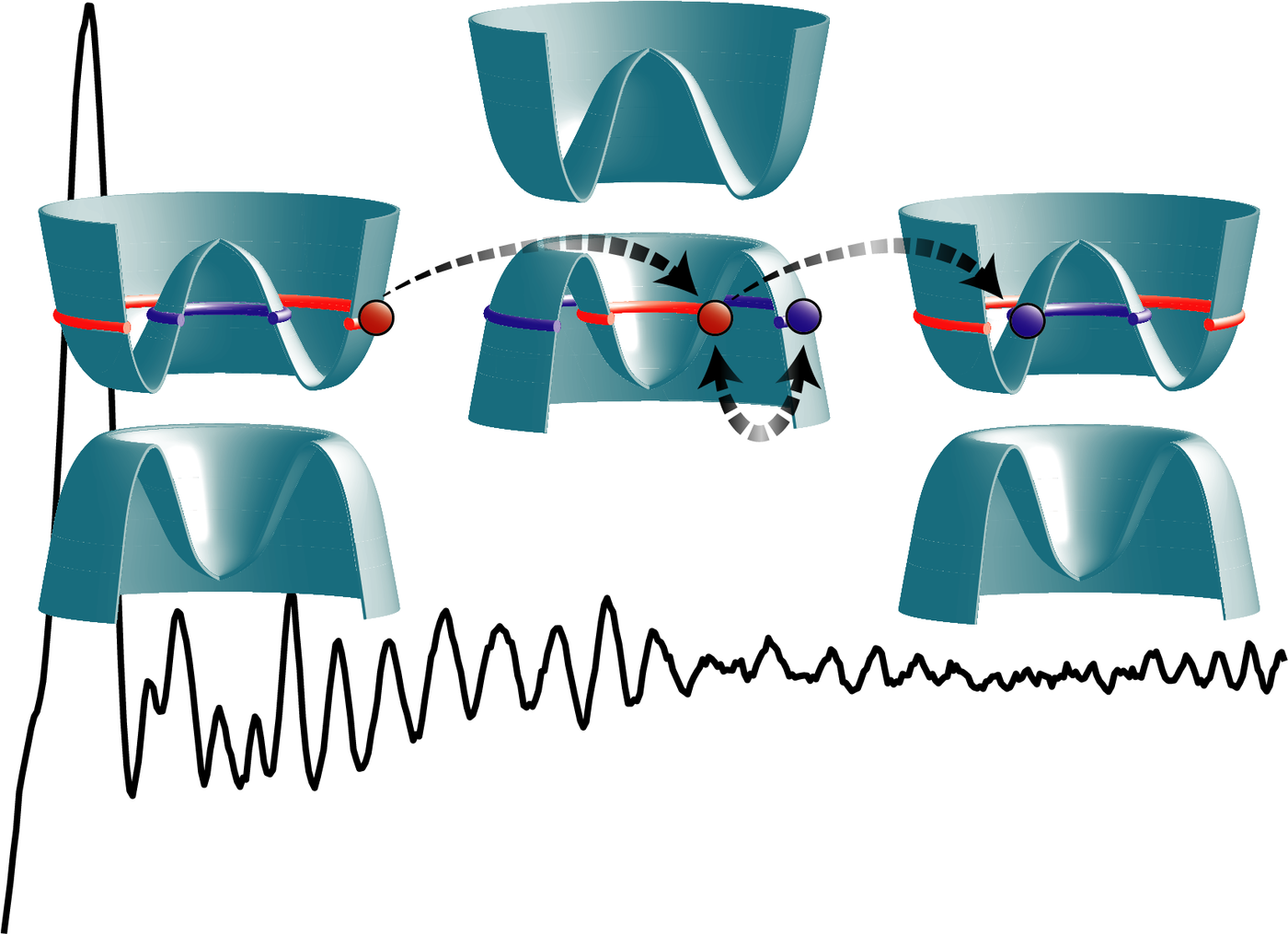
Electron-hole interference across an inverted-band bilayer and the resulting conductance oscillations

Electron optics aims to build micrometre-sized interferometers, lenses, collimators and beam splitters that manipulate electrons instead of light. Previously, such functionality had been demonstrated only in one-dimensional devices, such as nanotubes, and in graphene devices based on p-n junctions.

Together with experimental colleagues at ETH Zürich, we show a new mechanism for electron optics in two dimensions. In an InAs/GaSb double quantum wells, the conduction band of InAs and the valence band of GaSb are inverted and hybridised creating a sombrero shaped band structure. Using gates, we form p-n junctions that delimit a resonant cavity, a two-dimensional Fabry–Pérot interferometer in which the junctions act as semitransparent mirrors. The measured resistance shows regular oscillations, but only when electrons and holes coexist in the cavity; the oscillations disappear with increasing temperature, cavity length and magnetic field, as expected for coherent interference.

Using a minimal model of the band-inverted bilayer and a scattering matrix approach, we show that the interference is facilitated by electron-to-hole scattering. This effectively produces parallel one-dimensional channels that share almost identical conditions for constructive interference, so the oscillations survive the averaging over angles that normally washes them out in two dimensions. The mechanism extends electron optics to a broad class of materials with sombrero hat bands. Further, the electrostatic tunability of InAs/GaSb puts networks of such interferometers within reach.

See also ETH D-PHYS news: "A new path for electron optics in solid-state systems".

June 2020 Article

Emergence of criticality through a cascade of delocalization transitions in quasiperiodic chains

V. Goblot, A. Štrkalj, N. Pernet, J. L. Lado, C. Dorow, A. Lemaître, L. Le Gratiet, A. Harouri, I. Sagnes, S. Ravets, A. Amo, J. Bloch and O. Zilberberg, Nature Physics 16, 832 (2020)

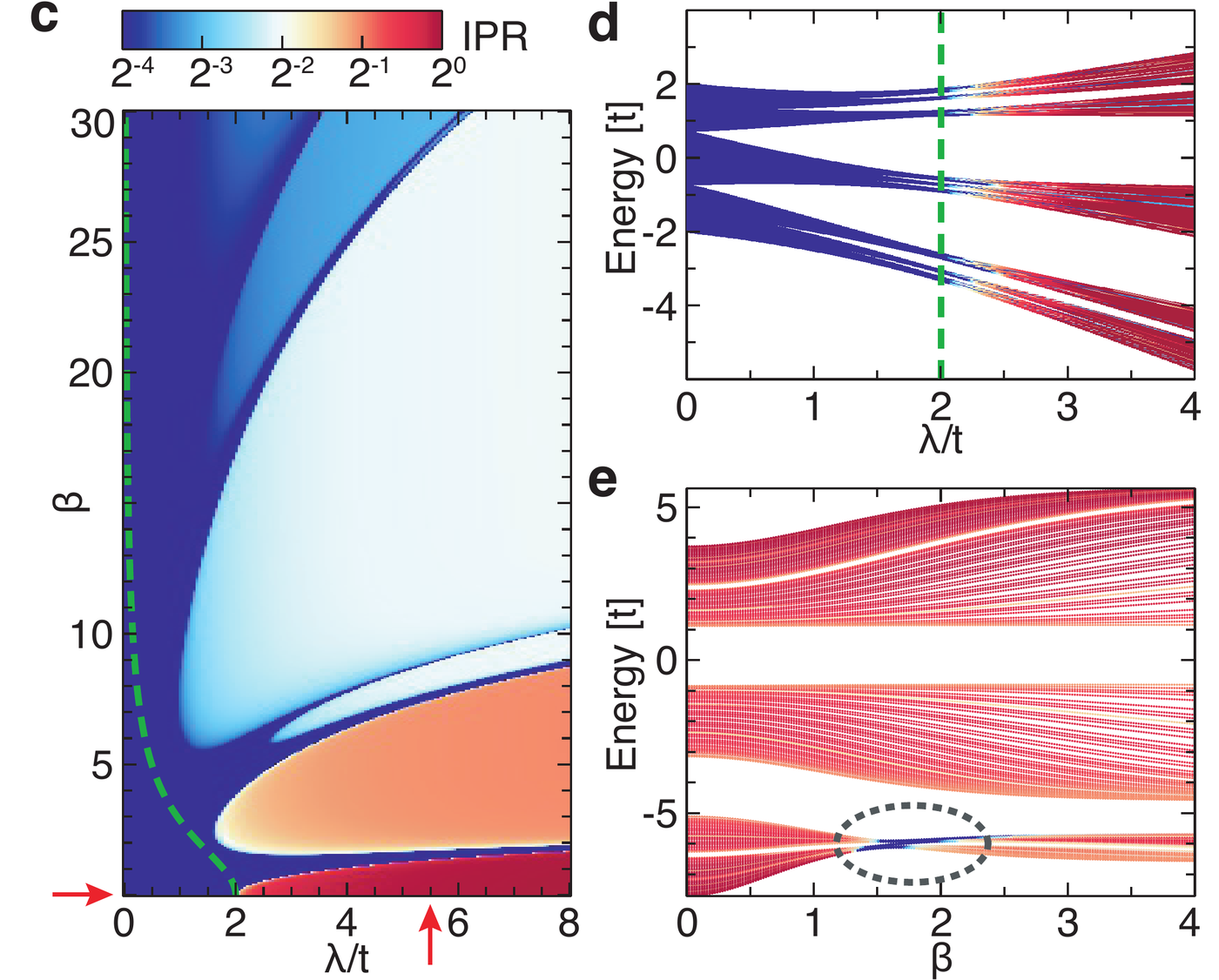
Inverse participation ratio and spectra across the Aubry-André to Fibonacci interpolation

Periodic systems conduct through extended Bloch waves, while disorder localises particles. Quasiperiodic systems, which are neither periodic nor disordered, lie between periodic and disordered systems and host exotic phenomena such as mobility edges, meta-insulator transition in 1D, critial wavefunctions, self-similar spectrum, etc. Two famous examples of quasiperiodic systems are Aubry–André model, which has a sharp metal-to-insulator transition of whole spectrum at the self-duality point, and the Fibonacci model, which is known to be always critical, with self-similar wavefunctions.

We connect the two models with a single interpolating model, i.e. the interpolating Aubry–André-Fibonacci (IAAF) model, in which a single parameter continuously deforms the smooth cosine potential of the Aubry–André model into the two-valued potential of the Fibonacci chain. We find that the Aubry–André model evolves into criticality through a cascade of band-selective localisation–delocalisation transitions. Neighbouring localised modes hybridise and delocalise, then localise again over twice the extent, and repeating this step iteratively builds up the self-similar critical wavefunctions of the Fibonacci chain. Furthermore, we predict, theoretically explain and experimentally observe, for the first time, the phenomenon of reentrant localisation, in which increasing the potential first localises the states, then delocalises them, and then localises them again.

Experimental colleagues at C2N realised these chains with cavity polaritons in one-dimensional semiconductor microcavity wires, whose width is modulated along the wire to imprint the potential. By imaging the polariton emission in real and momentum space, they observed the reentrant transition of the lowest-energy modes, in agreement with theory. Our results offer new insight into criticality in quasiperiodic chains, a knob to engineer band-selective pass filters, and a platform to study interactions and dissipation in quasiperiodic systems.

See also ETH D-PHYS news: "The cascade to criticality".