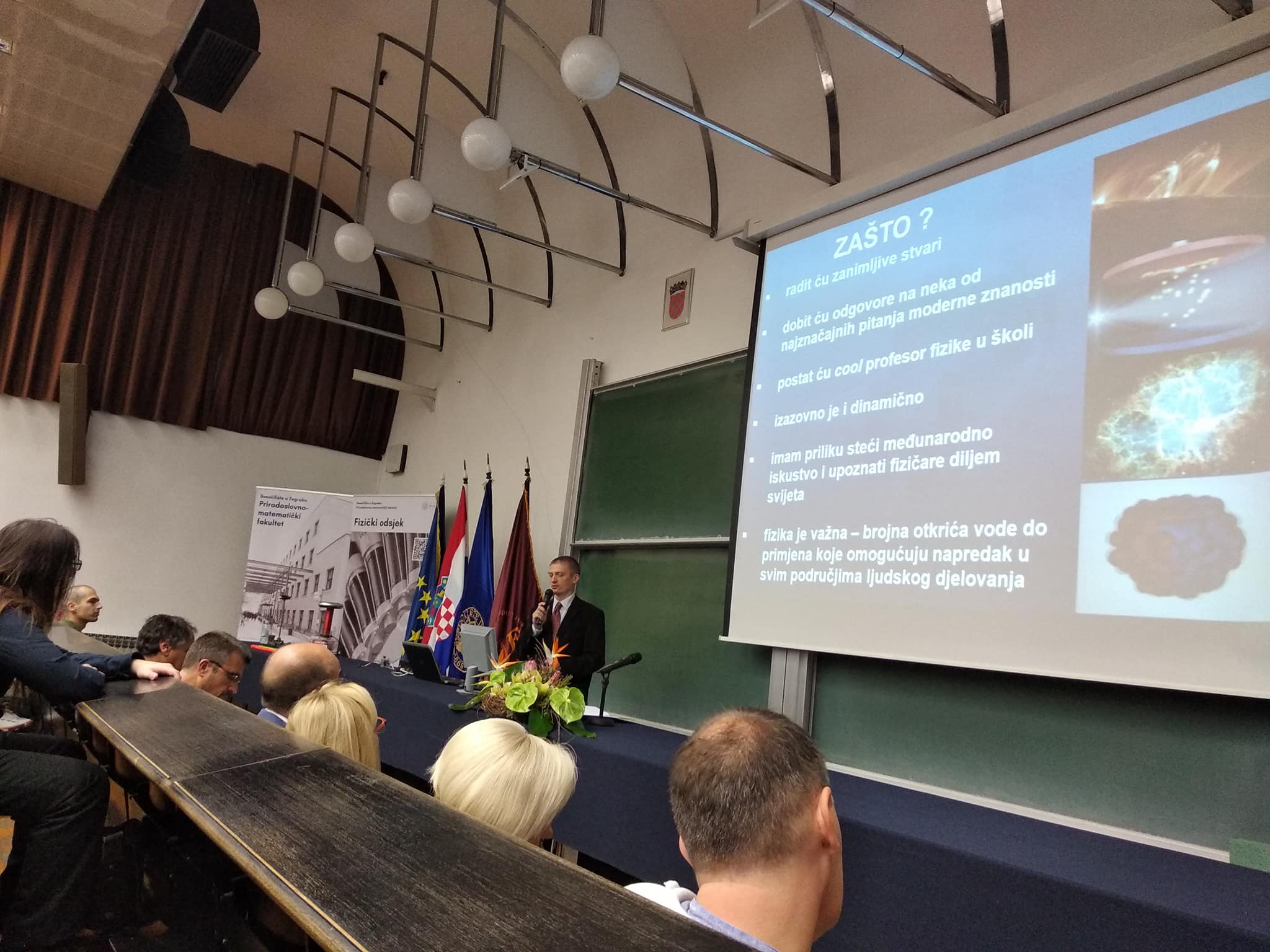
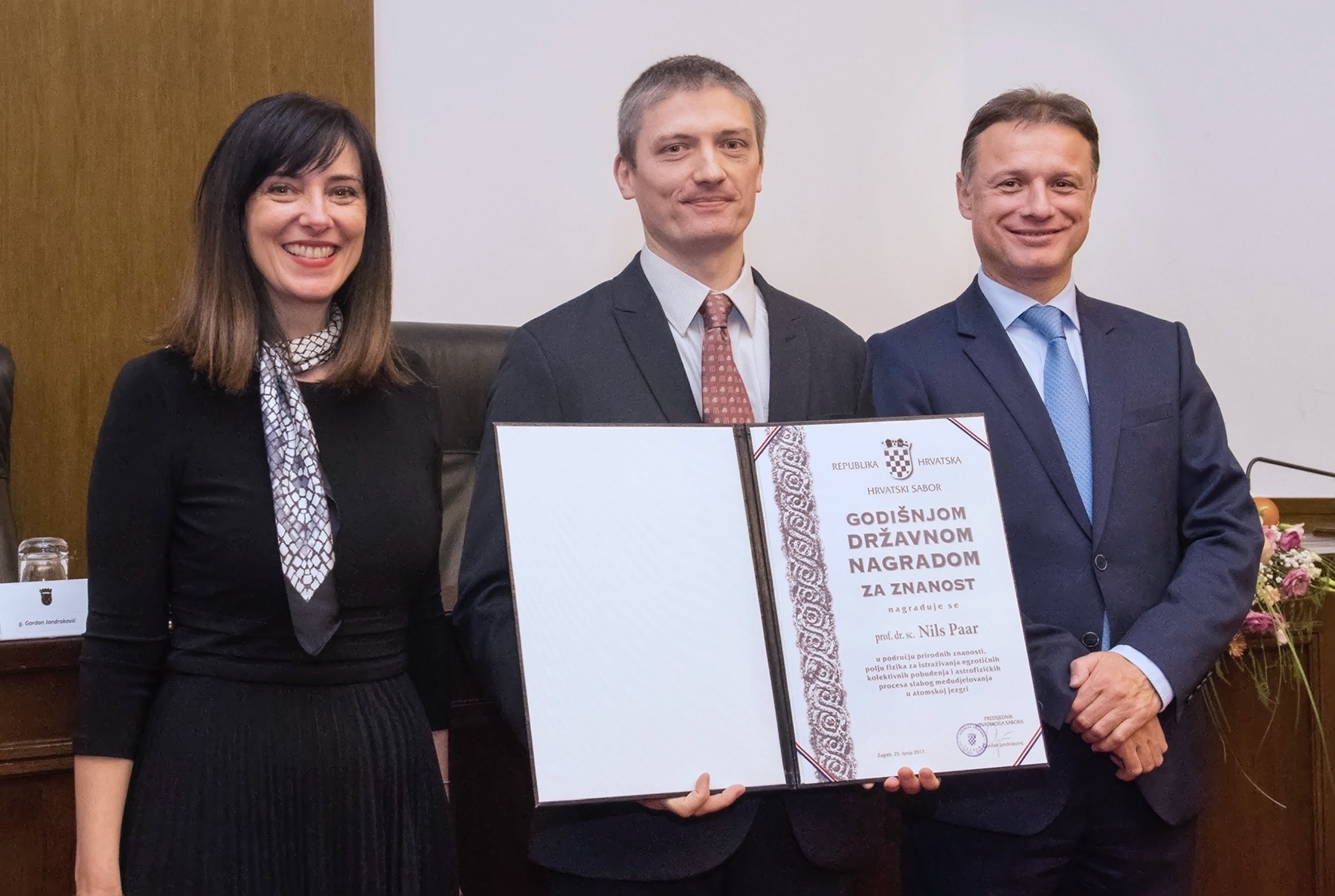
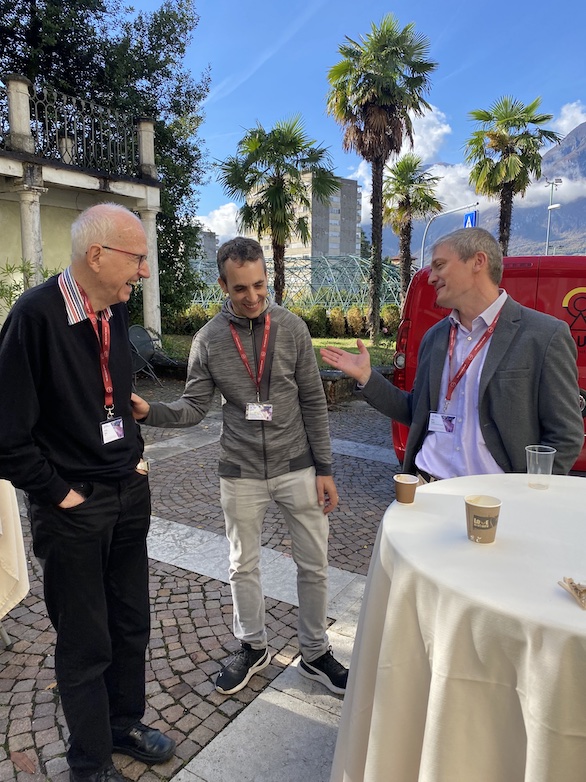
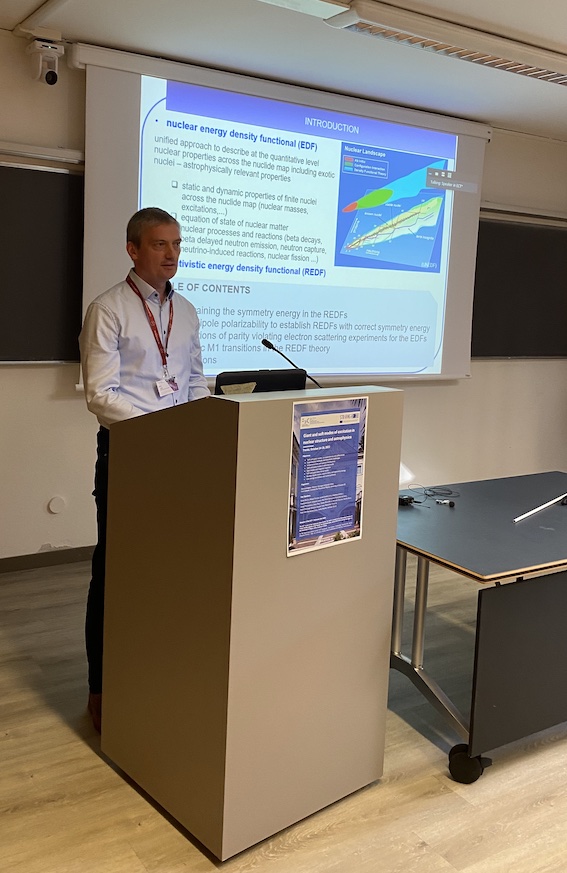



CONFERENCE PHOTOS


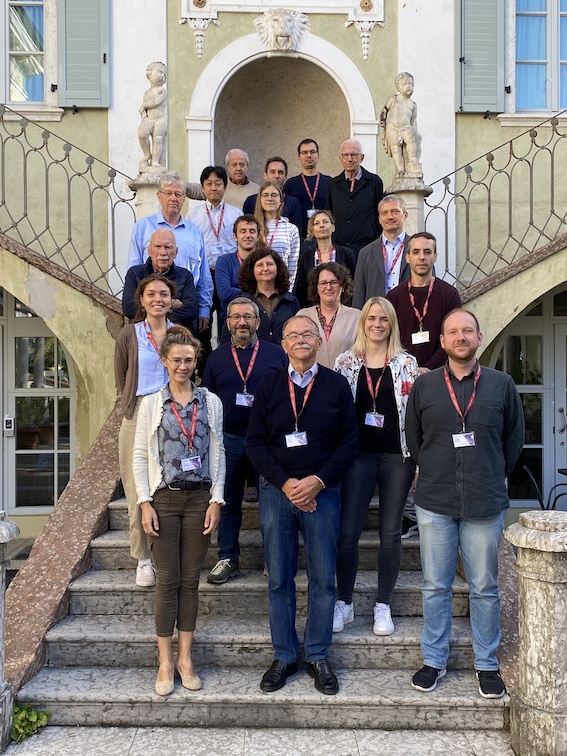
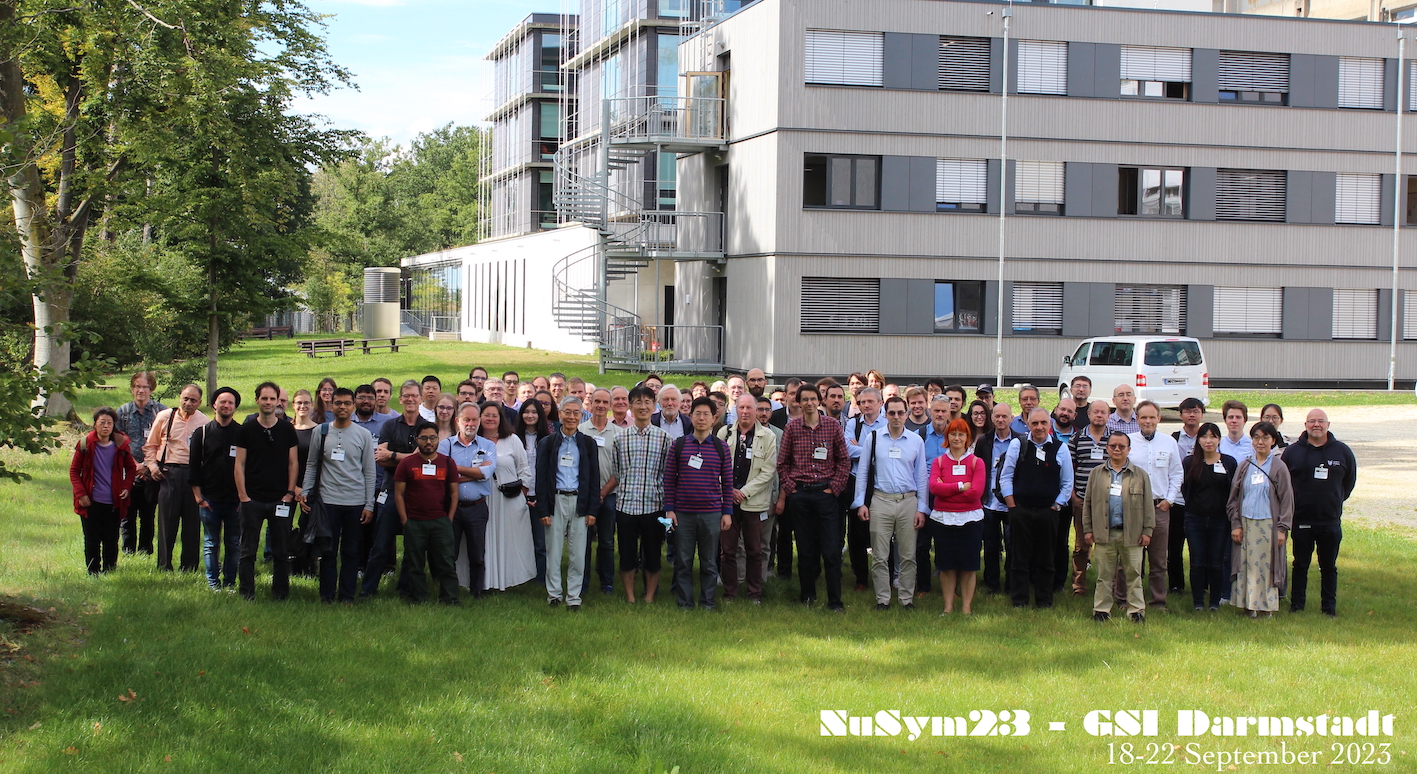
Tokamachi 2010

Brasov 2007                           Brasov 2007                          Bucharest 2007

Callaway Gardens 2004             Kazimierz Dolny 2005           Kazimierz Dolny 2005

Kazimierz Dolny 2005                           Tokyo 2006                          Istanbul 2004

Kos 2005                                                            Istanbul 2004


List of Contents:

SUPPORTED BY:


"On the isoscalar-isovector splitting of pygmy dipole structures", by N. Paar, Y. F. Niu, D. Vretenar, and J. Meng, Phys. Rev. Lett. 103, 032502 (2009).
nucl-th/arXiv:0905.4848


"Neutrino and antineutrino charge-exchange reactions on 12C", by A. R. Samana, F. Krmpotic, N. Paar, and C. A. Bertulani, submitted to Phys. Rev. C (2010).
nucl-th/arXiv:1005.2134


"The quest for novel modes of excitation in exotic nuclei", by N. Paar, J. Phys. G: Nucl. Part. Phys. 37, 064014 (2010).
nucl-th/arXiv:1002.4776

REVIEW: Exotic modes of excitation in atomic nuclei far from stability by N. Paar, D. Vretenar,
E. Khan, and G. Colo,
Rep. Prog. Phys. 70, 691 (2007).                                                                      Review is focused towards modern theoretical models for studies of multipole response in unstable nuclei and possible occurrence of new exotic modes of excitation in weakly-bound nuclear systems. Of particular interest are low-energy dipole modes from stable nuclei to systems near the particle emission threshold, various isoscalar modes, charge exchange excitations and their evolution in neutron-rich nuclei, the role of exotic low-energy modes in astrophysical processes, etc.

University of Zagreb

The University of Zagreb is one of the oldest universities in Europe, it was officially founded on 23 September 1669 by Emperor and King Leopold I Habsburg who issued a decree granting the status and privileges of a university to the Jesuit Academy of the Royal Free City of Zagreb. In naturalist field the teaching started in 1896, with first lectures in mineralogy and geology, and then in botanic, physics, mathematics, chemistry, zoology and geography. Today, the University of Zagreb is the largest university in Croatia with more than 50000 full-time students.

Physics Department

The Physics department at the Faculty of Science has a long tradition in teaching and in scientific research. Since 1991, after moving to the new building on Horvatovac, the Department had its renaissance. The new equipment considerably improved the practical side of the education process and experimental research. Studies of the Departments theoretical physicists have led to new discoveries in the process of neleptonic decay, research of cosmology of neutrino, nuclear structures, theory of classic and quantum chaos, low dimensional systems, and electron dynamics on the surfaces of conductor and isolators. Since 2005, the Physics department consolidated its transition towards Bologna system of study programmes. Within the academic year around 700 students are pursuing one of the various theoretical, experimental, computational and educational physics programmes.